Hi everyone! Most longtime regulars of the shop are used to being able to just arrive unannounced with books, but we are switching to doing appointments for trade-ins, so please do call ahead -- a week in advance if possible.
Starting July 1st, appointments will be available on Fridays, Saturdays, and Sundays. If that doesn't work with your schedule, please check with me, and we will work something else out.
Thanks everyone!! :D
Friday, June 20, 2014

Tuesday, April 1, 2014
Review: Gallows Hill-- a Salem mystery by Rory O'Brien

by Rory O'Brien
review by Michelle Souliere
When I picked up Gallows Hill, a murder mystery that takes place in the nearby and small-but-infamous town of Salem, Massachusetts, I wasn't sure what I would find within. It turns out that the book is an excellent, fast-paced police procedural mystery, as opposed to the New England cozy one might first expect from the location.
This is not to say that the location is not at the heart of this story. While it remains in the background, it is the constant, as it must be for the people who live their everyday lives there. It is this familiarity with the town that draws us in. It is a familiarity that cannot be faked, it must be given, and author Rory O'Brien gifts us with it gracefully and without us even realizing it.
That is because our attention is on the murder that has been committed, and a murder in Salem plays on a centuries-old history that lends itself to an innate alteration of context and meaning. The most innocent turn of phrase cannot be turned on one's tongue without exposing buried layers of hatred and madness from the Puritan witch hunts that went before.
While on the surface the murderer appears to play with Salem's historic triggers by placing the corpse on historic Gallows Hill, and scrawling pentagrams on the victim's palms, underneath this facetious drama lies a playing-out of ancient Salem family threads in a story all too modern, all too tied to the past.
O'Brien reels the reader in right from the start. There is no fluff in this story, no lingering too long on teashop scenes or lurid witchy ritual. The characters are each their own selves, clearly painted without the feel of cliché. Through them, the reader’s eye is turned to Salem's bare everyday heart, glimpsed clearly as each twist of the story plays out against the trapping of the town’s ever-present tourist kitsch. This is all done quite adeptly by O'Brien without any obtrusiveness. By the end of the book, the reader feels like they know Salem and its history, without quite knowing how they were told about it.
But – does the reader know who the murderer is?
Fans of "In the Woods" by Tana French and those who relish the wry and dry wit embedded in Jan Willem van de Wetering's Amsterdam mysteries will be as happy with this tale as I found myself to be.
P.S. BTW, this review was incredibly hard to write because I didn't want to give anything away about the story! So I had to focus on other elements of the writing instead. GO AND READ!!!
Tuesday, February 4, 2014
Review: Burstein's "Lincoln Dreamt He Died"
Review of:
Lincoln Dreamt He Died: The Midnight Visions of Remarkable Americans from Colonial Times to Freud by Andrew Burstein
 Lincoln Dreamt He Died is a smorgasbord of compelling and seldom-seen examples of very personal dream accounts reaching far back into our country's past. However, it stretches much further than that by tying those dreams into the very fabric of early American history.
What makes this book stand out from other dream books I've read (such as Brian Hill's Gates of Horn and Ivory) is that it is not an anthology. Instead, it is an intense and in-depth look at how Americans perceived their dreams, and how that viewpoint changed over the years as the country grew and matured.
Drawing from journals, letters, and various publications either recounting dreams or discussing opinions about dreams, author Andrew Burstein excerpts and synthesizes the widely varied material into a thread which follows the life of dreams in the minds of early American women and men.
How did early Americans respond to dreams? Did they dream, overall, similarly to how we dream today? Did dreams have real effects on their world?
As an amateur historian and folklorist I found this book absorbing. It represents a refreshing new outlook on the roots of the American viewpoint. You can tell how deeply Burstein immersed himself in the project by the way he occasionally refers to themes and patterns that aren't obvious on reading chapters for the first time -- and speaking personally this is not a drawback, as I'd rather go back and reread sections to really get a grasp on what the author’s point is, than to read the book once-through on a surface level only (which so many of those dream anthologies are delightfully geared to allow).
If you are interested in early American social history, and curious about how the internal world of dreams tied into and reflected the external world of centuries past, by all means, pick this book up. It is a fascinating window on the tandem worlds of the inner and outer lives of our predecessors.
Lincoln Dreamt He Died: The Midnight Visions of Remarkable Americans from Colonial Times to Freud by Andrew Burstein
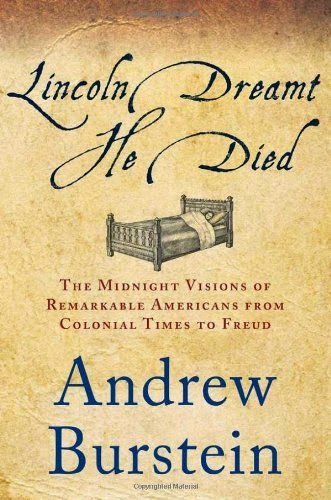
What makes this book stand out from other dream books I've read (such as Brian Hill's Gates of Horn and Ivory) is that it is not an anthology. Instead, it is an intense and in-depth look at how Americans perceived their dreams, and how that viewpoint changed over the years as the country grew and matured.
Drawing from journals, letters, and various publications either recounting dreams or discussing opinions about dreams, author Andrew Burstein excerpts and synthesizes the widely varied material into a thread which follows the life of dreams in the minds of early American women and men.
How did early Americans respond to dreams? Did they dream, overall, similarly to how we dream today? Did dreams have real effects on their world?
As an amateur historian and folklorist I found this book absorbing. It represents a refreshing new outlook on the roots of the American viewpoint. You can tell how deeply Burstein immersed himself in the project by the way he occasionally refers to themes and patterns that aren't obvious on reading chapters for the first time -- and speaking personally this is not a drawback, as I'd rather go back and reread sections to really get a grasp on what the author’s point is, than to read the book once-through on a surface level only (which so many of those dream anthologies are delightfully geared to allow).
If you are interested in early American social history, and curious about how the internal world of dreams tied into and reflected the external world of centuries past, by all means, pick this book up. It is a fascinating window on the tandem worlds of the inner and outer lives of our predecessors.
Thursday, December 12, 2013
A little Brautigan
A wee bit of poetry for your enjoyment this cold Thursday afternoon:
This is from Richard Brautigan's Rommel Drives on Deep into Egypt, wherein he waxes poetic in his own inimitable way.
(side note: we had some Brautigan arrive this week! Delicious.)
Have you ever had a witch bloom like a highway
on your mouth? and turn your breathing to her
fancy? like a little car with blue headlights
passing forever in a dream?
This is from Richard Brautigan's Rommel Drives on Deep into Egypt, wherein he waxes poetic in his own inimitable way.
(side note: we had some Brautigan arrive this week! Delicious.)
Tuesday, December 10, 2013
Review: Chain Saw Confidential
 |
| Signed copies available at the Green Hand Bookshop! |
There are certain horror films whose position in the pantheon of the genre are as solid as the stone pedestals we horror fans place them on. These are the films whose effect and mastery of that effect are undeniable. Texas Chain Saw Massacre is one of them.
This book wholly does the film justice. Gunnar Hansen is not just a pretty face who starred as the original Leatherface in the 1974 film Texas Chain Saw Massacre. He is also a published author who has written page after page of non-fiction and poetry over the intervening years. In other words, when you read this book, you are reading Gunnar's writing, not that of a ghostwriter -- which is not to say he did this all alone.
One of the tremendously interesting features of this book is the input from the other cast and crew members that worked on the movie. Not content to simply rely on his own recollections, Gunnar smartly contacted everyone he could, and interviewed them in-depth about their recollections, in effect generating a panoramic view of their group's experiences that hot summer in Texas. Because of his hard work putting all of this together, all these little details metamorphose into a real story that is surprisingly pleasant to read (in spite of all the incoherent and horrific details). Without his labor of love, such an account might never exist. For that we thank him.
The book is filled chronologically with page after page of Gunnar's individual recollections, which parry back and forth with those of the rest of the cast and crew. Everyone has their own take on strange and favorite details from the experience. Everyone also has their own blanks spots where they rely on the others to fill in the gaps, because the filming was excruciating and exhausting, and very little of it made sense at the time. But after all the chaos and agony, the important thing about the movie (which thankfully came out through the editing in the final version), was this: not only was all that suffering palpable in the film, but also, more importantly, it was transmuted into something that shines its dark and brilliant light from the screen even today.
The book as a whole continues this tradition of craftsmanship. Gunnar is an excellent writer, adeptly weaving his own memories in with the others', working from a solid foundation based on thorough research into the historic facts and figures. This volume, published by the folks at Chronicle Books, is beautifully designed and bound (yes, it has an honest-for-real sewn binding). For the uber-geek, it has a bibliography and a serious index. Even its chapter titles are entertaining and hearken to the dark heart of the film.
 |
| Gunnar adds his autograph to its future permanent home -- she was headed to a tattoo artist next! |
I highly recommend this book to anyone fascinated by movie-making, to anyone who wonders what the heck all the fuss over the Texas Chain Saw Massacre was about, and to those who shake their head at that question, because they just know.
Copies of the book are available at the Green Hand Bookshop -- SIGNED copies! :D A perfect gift for the horror film fan in your life... or yourself!!!
I am lucky enough to have signed copies at the shop because I had the pleasure of being Gunnar's local retail representative during the weekend of November 9th and 10th at the Coast City Comicon. For two days, I got to hang out with Gunnar and his wife Betty, selling his book and chatting with them about all sorts of things. They came down to Portland from their home up the coast near Bar Harbor, Maine, where they live full-time, and have for some years now. Gunnar was selling signed photos from his movie appearances, and on Saturday he participated in the Chainsaw Chili Cookoff at the Comicon with a number of other contestants. His chili was the only chili that was traditional Texas style, without any real bean quotient. I heard it was DELICIOUS!!!
 |
| A weekend with Gunnar! |
Subscribe to:
Posts (Atom)


 Posts


